Monday, December 30, 2013

Goals that are Somewhat Adjacent to the New Year

My friend Lee posted in his blog about New Year's resolutions and his general dislike of them. I enjoyed reading it, particularly the part where he addresses the type of resolutions where people basically want to complete change themselves. That struck a nerve with me. I'm in a position now to look back at the "everything about me must change!" phase of my life from a very safe and comfortable distance, and it is good to reach that point where I can feel sorry for the version of me that wasn't very happy with herself but also glad that she no longer exists. And I'm just glad to have a general sense that I like the current version of me quite a lot.
Also, it reminds me of this Amanda Palmer song. Because, you know. Pretty much any Big Thing I Have Learned has been sung about by Amanda Palmer at some point or another.


So Lee's post got me thinking about New Year's resolutions and how I don't really do them either, and the very nature of them goes against the whole thing of being happy with myself. I think it's ok to want to make some changes, if those changes are going to make me happier. And by that, I mean really, actually happier; not happier in that magical thinking kind of way that goes "I bet if I weighed less I would finally be happy", because depression is not stored in fat cells. I mean things that tap into the stuff that really actually makes me feel satisfied with myself.
Also, I tend to go through certain phases in my life, and often those phases run sort of along the cycle of a year. At the end of last summer, my year-long-ish travel phase ended. I had a great desire to be adventurous and see new places and do new things, and travel for no reason other than because I could. But I got really tired in New York City, as if all the travelling finally caught up with me. And the end of that phase led directly to the one I'm entering now.
So instead of resolutions, here are the things that I feel like doing this year just because they will make me happy:

Keep a home that I feel happy in. I have somehow evolved into a tidy person. I think part of it is being an introvert in the true Jungian definition of the word in which I recharge by turning inward (as opposed to the Tumblr definition of the word in which an introvert is a special, special snowflake with unique thoughts and feelings that are hindered by a severe anxiety disorder). I'm a social, talkative introvert! But nonetheless, I want to go home and hug my cat after every adventure, and when I do, I feel more relaxed and happy in a tidy home. I also want to work on my home decor more, just because it makes me feel satisfied with how my place looks.
Do creative things. There are new costuming techniques I want to try out. I want to learn leather working. I want to try out a few techniques that are completely new to me. But I also just want to remember that sometimes, the best remedy for stress is to stop sitting around and go do something creative. Play music, draw or paint, make a little art, even if it is small and simple art that is just for my own enjoyment. Especially if it is just for my own enjoyment.
Remember that eating good food and exercising makes me feel better. See what I did there? Eat better and exercise more is probably the most common resolution, but this list is about what I want to do to be happier this year, and not about resolutions. Also, for a long time I've challenged the ideas behind that very common resolution, and all the body image/societal expectation/beauty standard baggage that goes with it. And what I've concluded is that a skinnier, fitter me does not result in a sexier, more popular, better me. So rather than go with the standard resolution, I just want to stay in touch with this truth. I like the instant gratification of fast food. It is my favorite fix if I want to feel good for 30 minutes. But if I want to feel good every day when I wake up, I do that by eating more fruits and veggies and exercising almost every day.
Eat things I love. Sort of goes along with the last goal. When I'm not seeking instant gratification, I'm happiest when eating the food that I make for myself, because I like my cooking. I also want to drink more tea - just because I like tea a lot, and I've learned that I enjoy it most when I keep a lot of varieties around to choose from.
Remember that reading makes me feel like I'm doing something just for me. I have no interest in high-minded self improvement here. I'm not even convinced that reading is somehow better for you than, say, watching good movies or shows. I just like to read, and it always makes me feel relaxed and a little pampered. Which is why I'm posting this here. I hope to resurrect the book blog this year, because I also enjoy writing about the books when I finish them.
Forgive myself but remember that accomplishment is satisfying. At times, I need fast food instant gratification. At times, I need to leave the home messy and not worry over it because there's a lot going on in my life. At times, I need to just sit around and play video games for a couple of hours, which excludes the option of getting anything done. And that's fine. Everyone needs a break sometimes. Just so long as I can continue to accomplish things I want to do, because ultimately I'm more satisfied with myself when goals are accomplished.

Wednesday, May 9, 2012

Hiatus

It's been a while.
Since my last post, I finished the Time Traveler's Wife (it was ok, and raised questions about free will), read Guards! Guards! in the Discworld series (it was funny), and then tried to read a Connecticut Yankee in King Arthur's Court.
Tried.
It's not a long story. But it's basically an essay in the form of a novel, which I find really boring. I just couldn't finish the thing.
So I gave up on a book for the first time since I started the reading list.
I read Eric in the Discworld series (it was very funny and also a quick read). But once I was done with it, I found I just didn't want to return to the list. I wanted to re-read The Handmaid's Tale by Margaret Atwood (which is on the list, actually, but re-reading it is not part of the plan). And now I want to read Fables graphic novels. And I think after that I want to read A Game of Thrones, or maybe something by China Mieville.
Clearly my mind is wandering.
So for now, I'm taking a break from the list, reading only for enjoyment. I'll be back later.

Sunday, November 20, 2011

Haunting of Hill House finished; The Time Traveler's Wife started

I only have a couple of recurring dreams. Both of them are nightmares, both of them are about houses. The first involves being in a house that goes on forever - like in a Flintstones cartoon where Fred is running, and he is in the center of the screen as the wall of the house scrolls by endlessly until he smashes into something (and that something is never the adjoining wall). There are windows all along the walls without stopping, and there are things outside that want to get in. It's like living in a school hallway (if your school was always in danger from marauders, that is).

The other dream is that I live in a very large house. It has a lot of rooms, and I keep forgetting that one of them exists. I will suddenly discover that room, and it makes me feel really nervous, like all along the room has been hiding from me. Why would it do that? What's it got to hide?

I've been in houses that feel warm and inviting instantly. I've been in houses where I feel unwelcome if I'm left alone there without the owners. My first girlfriend rented an old house that had a dirt cellar between the kitchen and the back door. A friend of hers who claimed to have psychic abilities said that a child had once been abused there - locked up and forced to live in this small room on the dirt floor. I don't know that I believe in her psychic abilities, but no one liked that room. If she or her roommates had to go through it to the backyard, especially at night, they would run through it as quickly as they could.

When I was in my early 20s, I spent a lot of time house-sitting for other people. It was a way to both make money and live in a place that was totally mine for a week, and all I had to do was take care of other people's pets. I learned a lot about what makes me happy or uncomfortable in a house - high ceilings are bad. So are windows that can't be covered. Small entertainment rooms - "man caves" if you will - are good. The house I was most nervous in was occupied by four cats. All my other customers had a variety of pets, but also at least one dog. Dogs make a place better. Whenever I buy my first house, I plan to get a dog within my first week there.

Haunting of Hill House taps into this exact kind of delicate discomfort with houses. What makes a house feel inviting? What makes it feel unwelcoming? The house is described as having a strange architecture - uneven lines, a lack of symmetry, doors in unexpected places. I imagine Shirley Jackson had the Winchester Mystery House in mind when writing it - Hill House is not that extreme, but definitely borrows a lot of its terror from strange appearances. Eventually it does more than just look unsettling, as it's evil spirits begin to work on the minds of the visitors, all of whom have shown up to observe and collect data for a doctor who enjoys researching the paranormal. Of course, science and logic are no match for the horrors within the house. Still, despite the story's age it still contains some real genuine moments of terror as the house seeks to destroy the visitors.

They should have brought a dog with them.
----------------------------------------------
I've started The Time Traveler's Wife, which was made into a film not long ago. All I know about the film is that it wasn't very good according to everyone I know who has seen it. I've really enjoyed the book so far, though.

Sunday, October 9, 2011

Pyramids finished; War of the Worlds finished; Dragon*Con visited; Haunting of Hill House started

I've gotten behind on my blogging due to costuming, Dragon*Con, and life in general. So here's a quick review bringing this up to speed.

I finished yet another Discworld novel, although finished much more slowly due to my heavy costuming regiment.
In Pyramids, Terry Pratchett takes on a very ancient culture in order to poke a little fun at ancient cultures in general. Pteppic is the son of the king of Djelibeybi (ancient meaning: child of Djel), and is sent to the assassin's school in Ankh-Morpork. While there he picks up many modern habits, and becomes better known as Teppic. When his father dies he has to return home and figure out how to be king, while also trying to figure out how to live in a country that hasn't changed for thousands of years.

As usual, Terry Pratchett pokes fun at many things that we romanticize and seldom question. In this story, the foolishness of preserving tradition is called out for examination, as we learn that Djelibeybi is bankrupt as a result of spending so much money on pyramids for deceased royalty. Because this is the Discworld we are able to see into the lives of dead people, and we learn that the Djelibeybi belief that death is when you really start living is incorrect, and Teppic's dead father is just hanging around near his own dead body and rethinking his beliefs.

It was good with several laugh out loud moments, which is about what I expect from any Discworld novel. Terry Pratchett just keeps adding to the number of novels I need to finish with this list as the Discworld catalog continues to grow, but they are always fun to read and I look forward to getting to some of the more modern entries in the series.
----------------------------------------------------
I also took an unusually long amount of time to finish H. G. Wells's War of the Worlds. Partly this is because I picked it up from the library prior to Dragon*Con, which meant that I didn't even get started on it until after the con. Partly, this is because it was boring. Yes, it's a very short book but it is really dull. It's written as a first person account of the invasion of Victorian England by martians, and it describes every small event in detail.

Part of the problem here is that I am not familiar with the British countryside. It's clear that the details were meant to allow readers to envision the path of the martians across the land. Partly, the problem is that the descriptions of the martians and their technology have been so frequently used in sci fi that they are now outdated.

At any rate, it felt like work to sit down and read it for a while. The story is completely predictable if you've ever seen one of the movie adaptations (I've seen the 1953 film) or heard the Orson Wells radio drama (which might be the best way to consume this story).
------------------------------------------------
Next up: it's October, so it's time for a horror story. My choice this year is The Haunting of Hill House by Shirley Jackson. I'll also be putting up my review of Dragon*Con soon.

Saturday, July 9, 2011

The Amazing Adventures of Kavalier and Clay finished; Pyramids started

I've finished The Amazing Adventures of Kavalier & Clay by Michael Chabon, a 600+ page book that I made the mistake of starting right at the same time that I began to get seriously into my costuming for Dragon*Con this year. Not the best of timing. The only thing that kept me going instead of setting it aside for later is that whenever I could make time to read it, I found it completely delightful.

For starters, this book does not fit into the description of this reading list. It's not sci fi, fantasy, or horror. It's simply a history of two men working in the comics business between 1939 and 1954. But the fact that it doesn't fit in doesn't matter. It is a great story, and I'm glad I had the opportunity to read it.

The book follows Joe Kavalier, a Jewish immigrant from Prague who moves to America as a young man to escape the Nazis, and his cousin Sammy Clay, whom he comes to live with in New York City. Sammy sees that Joe has a talent for drawing and gets him a job drawing comics, which Sammy has a knack for writing. The story follows the two of them through the next 15 years as Joe struggles with his rage against Hitler, and Sammy struggles with his feelings of inadequacy about his job and his life. Much like any year-spanning story, the characters lives have their ups and downs, filled with victories and tragedies.

This would be a fine story by itself. I've enjoyed many movies like this - narratives that take in a lengthy span of time to demonstrate the shared experiences of human life and the nature of change. But the story is much more than that, and all because of comics.

The story takes place during the Golden Age of comics, when superheroes were created, and the books enjoyed tremendous popularity. This is a time period highly prized by fans of superheroes and collectors who covet original first editions. It is also a time period I don't relate to easily. I'm not a big fan of superhero comics, and usually only read the ones that stand out in some unique way, like Frank Miller's Batman books. As such, it's even more difficult for me to take interest in the Golden Age stories. Having read American Splendor, Fables, Kabuki, Maus, Sandman, Sin City, Watchmen, it's hard to be satisfied with the simpler stories of that age. I recognize that like all art, those comics represent some fundamental things about that age, but I simply find more modern stories more satisfying.

However, perhaps the best way to experience something you don't relate to is through a story of people who do, who care for it so deeply and emotionally that it transforms their lives, which is what makes Kavalier and Clay so beautiful. Chabon's writing describes this affection poetically, without straying into cheesy nostalgia: "Most of all, he loved them for the pictures and stories they contained, the inspirations and lucubrations of five hundred aging boys dreaming as hard as they could for fifteen years, transfiguring their insecurities and delusions, their wishes and their doubts, their public educations and their sexual perversions, into something that only the most purblind of societies would have denied the status of art.
"Having lost (a lot, ok? No spoilers) - the usual charge leveled against comic books, that they offered merely an easy escape from reality, seemed to Joe actually to be a powerful argument on their behalf."

I can't recommend this book highly enough. Read it if you love comics, or ever have. Read it if you've never gotten the whole comic book thing, or if like me you prefer your superheroes in summer movies.
----------------------------------------------------------
Pyramids (Discworld Book 7)
I'm starting Pyramids by Terry Pratchett next, mostly because I need something simple while costuming. This continues the Discworld series with a story about Teppic, an adolescent who is yanked from Ankh-Morpork's assassins' school when his father dies, so that he may become the next pharaoh.

Thursday, May 26, 2011

The Man in the High Castle finished; Affinity started and finished; about to start Kavalier and Clay

After I finished The Man in the High Castle, I went right out to the library and got Affinity, and became so engaged in it that I couldn't make myself sit down and write a blog post. So now I'm doing a double post to take care of both of these titles.

----------------------------------------------------------

The Man in the High Castle is by Philip K. Dick, who I like quite a lot. I started out this project reading Do Androids Dream of Electric Sheep? and vowing to read more of his work when I finish this list. He does a few things in that book that I tend to like in general - mainly, the  book is clearly about Big Ideas but also allows you to draw your own conclusions about them. It's open to interpretation.

So is The Man in the High Castle. It takes place in an alternate history in which the Axis won WWII, and in which the world is divided between rule by Italy, which has very little territory and influence in a post-war world; Japan, which controls quite a lot including California, where most of the story takes place; and the Nazis, who not surprisingly are becoming a bit uncomfortable with sharing all this stuff with Italy and Japan.

In post-occupation California in 1962, most people are using the I Ching daily as a result of Japanese cultural influence. There are numerous story lines going on simultaneously that intersect in a variety of ways, but it's the I Ching that almost everyone has in common. That, and a book called The Grasshopper Lies Heavy, which is illegal to own in the United States and is an alternate history of their alternate history world, in which the Allies won WWII. Despite the fact that it's illegal, practically everyone is reading it.

Other than that, there's not much I can say about the plot that gives you a sense of the book. There are numerous themes going on, including a lot of discussion about things that are counterfeit and real and the value of one over the other. There's the issue of creating new American products in California when the only things the Japanese want from the Americans are the artifacts of their past - comic books, Mickey Mouse watches, etc. There's the basic falsehood of ethnic superiority, which is explored through Nazi and Japanese influence, as well as the resentment that the occupied Americans have against their captors. And there's the theme of alternate realities, explored through the story's own alternate reality and the additional alternate reality of the story within the story.

These are interesting ideas, and I like that the author always lets us figure this out for ourselves. I believe this is probably why I like his writing so much and dislike Robert Heinlein in a way that seems directly opposite - all the long winded lectures in Heinlein's Stranger in a Strange Land direct you towards the precise meaning of the book, in an undeniable way. I prefer Philip K. Dick's style, which lets us interpret his work as we please. After all, we tend to interpret these major themes he discusses based on our own thoughts and experiences. In a book in which the author tells you exactly what to get from it, I tend not to spend any time considering the meaning of it (why bother. The book has already told you what you are meant to think). I just start judging based on what I think of the idea being pushed - not to mention the fact that I dislike the writing style of any story in which the author's point of view is directly stated.

However, despite the interesting themes, I thought this book ended surprisingly abruptly, and I felt like a lot of the story lines were never fully tied up, or did not end in a satisfying way. According to wikipedia, Philip K. Dick used the I Ching to write this book and stopped it when the I Ching had nothing more to say. I feel like this contributes to the book leaving off so abruptly, and I'm dissatisfied with the open ending.
----------------------------------------------------------

AffinityI went from that straight into a book that was not open ended at all, and which really surprised me in the end. Affinity is by Sarah Waters. I read her book Tipping the Velvet previously, and had a general sense of what to expect - she's a modern day author who sets her stories in Victorian England, giving them a delightful blend of the things that we still find alluring about the Victorians, without also engaging in the dry and long-winded prose of that time period. She also writes mostly about women and specifically about lesbians.
As it turns out, going into Affinity with the expectations set up by Tipping the Velvet  really blind-sided me. Tipping the Velvet was an adventurous tale, in which a woman discovers her sexual identity while going from working in the theater, to prostituting herself to survive, to become a kept woman for another woman, to working within a political labor movement. It does the exact opposite of the typical Victorian novel by exploring the world of someone who is not a member of the upper class without also trying to convince you that people like her are charity cases. It demonstrates what a woman in her station might need to do to survive - but also that a woman with gumption might be able to deal with it pretty well.
Affinity, on the other hand, is about a member of the upper class who visits a women's prison specifically as a sort of charity work - it's expected that being exposed to a lady will help with the reformation of the prisoners. We learn over time that the main character, Margaret, suffers from depression and attempted suicide prior to the events of the novel. Her depression results from her love affair with a woman named Helen, and from the end of their relationship which was soon followed by Helen marrying Margaret's brother. Through volunteering at the prison, Margaret meets and becomes enchanted with Selina Dawes, a spiritualist who was arrested for assault in a situation that occurred while she was channelling a spirit, in which she claims that she was wrongly accused for things that were done by the spirit.
This story is much darker than Tipping the Velvet was, partly because of the prison setting, and partly because of the gloomy weather - the description of the heavy fogs that infected Victorian London due to industrial pollution makes it sound like Margaret is living in the nuclear winter of a post-apocalyptic world. A great deal of the darkness comes from the fact that the story is mostly narrated by a woman who is suffering from severe depression; where Tipping the Velvet's Nancy maintains a good disposition based on her willingness to make due with whatever happened to her, Affinity's Margaret sees herself as a prisoner of the social standards of Victorian upper class society. Having read only these two stories, I can't help but wonder if this is a statement by Waters about the upper class versus the working class.
The story involves a few elements that I expected based on Tipping the Velvet: there is a lesbian relationship. The main character has suffered a failed relationship with a woman who was unwilling to go against social standards for love. The main character experiences a painful breakup and then falls in love again (instead of just pining away as if that one love was all that she could ever have).
But overall, the fact that there are lesbian characters is just as much a circumstance of the author's own background as the fact that they are also British. It's not so much a lesbian story as it is a story with lesbians in it.
I'm also not fully sure it's technically a work of either fantasy or horror. It's definitely a Gothic Victorian tale, but the actual supernatural elements are somewhat dubious. The main character is being treated for her depression with chloral and laudanum which - it becomes eventually clear - she is taking in increasing doses, and it's difficult to tell reality from her own delusions.
Regardless of the story's fidelity to the theme of this list, it was a very good read and engaging from start to finish. Waters has a lush descriptive style that gives Victorian England a textured realness. The book also seems to be heading towards an obvious conclusion, and then surprisingly deviates from that in the end. Overall it was an engaging tale with a very solid ending, which made up for my dissatisfaction with The Man in the High Castle's inconclusive ending.
----------------------------------------------------------

Next up I'll be reading The Amazing Adventures of Kavalier and Clay, by Michael Chabon. This one has been listed as a favorite by a number of authors I like, but other than that I don't know a thing about it.

Tuesday, April 5, 2011

The Man Who was Thursday finished; The Man in the High Castle started

G. K. Chesterton is one of those writers that people who I read love to read. Frequently (when I'm not working on a massive list of books), I take suggestions on reading material from the favorites of my favorites, so I probably would have gotten around to The Man Who was Thursday one day, no matter what.

Reading it, however, I kept feeling like I was supposed to be getting more from it than I was. It's funny at times, and it has a clear message (which I can't give away without spoiling the whole thing). I do like stories with clear messages. But it also was clearly leading up to a twist ending which is very easy to see coming. Overall it was OK, and definitely not a difficult read. I'm still not sure what to make of it, entirely. If you are a fan, post your thoughts on the novel.
------------------------------------------------
The Man in the High CastleNext up is The Man in the High Castle by Philip K. Dick. Hooray! If you go all the way back to the beginning of this blog, you'll see that the first book I read on the list was Do Androids Dream of Electric Sheep? by Philip K. Dick. Ever since then I've wanted to start this novel, and then perhaps abandon the list until I've read everything Dick wrote. He's been one of the great finds of this reading list, and I do not doubt that I will become a major fan of his work once I have time to get into it all.

I'm already well into The Man in the High Castle, and I love it. It speculates on an alternate history in which the nazis and the Japanese won WWII, and now control America as a result.

Friday, March 4, 2011

Wyrd Sisters finished; The Man Who Was Thursday started

Around about Mort, I reached the point where the Discworld novels really pick up speed. I had faith that the books were getting there - I'd read Good Omens and knew that Pratchett's comic writing was solid. Additionally, these are extraordinarily popular books. There's bound to be a reason for that. So I had a feeling it just needed time to get going.

Now, I have talked to a few people who have told me that they feel as if they didn't quite get the big deal with Terry Pratchett. They tried reading the Discworld books, and just didn't care for it. I wonder if those people started at the beginning - because in the first couple of books, Pratchett is clearly still discovering his style.

The Man Who Was ThursdaySo if you've tried to read the Discworld books from the beginning and just haven't been able to get into them, I recommend you start with Wyrd Sisters. You don't have to start from the beginning. The books do not carry on a greater storyline - there are times when characters from one book show up in another, but they are not telling a bigger story in which you are missing out if you fail to read those others. There's no need to be a completionist. You have permission to start wherever you like.

But the reason you should start here is that Wyrd Sisters is so spectacular. It spoofs Macbeth brilliantly throughout the story - imagine Macbeth from the witches' point of view, if the witches were actually reluctant to meddle, or even reluctant to be in a coven. It has also been the funniest so far. Give it another shot. The payoff is worth it.
--------------------------------------------
Next up I'm reading The Man Who Was Thursday by G.K. Chesterton. All I really know about this book is that lots of writers I like recommend it (which is certainly good enough for me). All I really know about Chesterton is that he inspired Gilbert (aka Fiddler's Green) in the Sandman comics by Neil Gaiman.

Monday, January 31, 2011

The Road finished; for the love of God please let me read something funny

The Road --2007 publication
I checked The Road out of the library on last Wednesday. I finished it today (Monday) - which has got to be a record for me. One thing I can say about The Road - the story definitely pulls you forward. There are no chapters, no clean endings to the trials and perils that the characters face, just breaks between moments. It kept me reading.


But that same quality meant I could not put it down last night, until it got very late into the evening, which meant I had to sit up and watch a few minutes of Ocean's Eleven on TV to clear my mind for a while before sleeping. Because this story is an absolute nightmare.

If it were not on my reading list, I don't know if I would ever willingly read it. I believe it is the bleakest story I've ever read. And that's considering that I really enjoyed watching No Country for Old Men (adapted from another one of Cormac McCarthy's books).

The story is about two nameless characters, a man and his son, in a post-apocalyptic world. The event that caused the apocalypse is never fully described, but the boy was born soon after it occurred. Now he is older and he and his father - alone, because the mother committed suicide - are travelling south through America to try and find someplace warmer. On the road they have to scavenge for food in abandoned stores and houses because all wildlife and virtually all plant life has been killed off by the unnamed event. They also have to avoid roaming bands of marauders who have turned to cannibalism in order to survive. Meanwhile, the man tries to preserve his son's innocence and goodness.

The story is quite moving, and it's easy to see that it has earned its rave reviews. McCarthy demonstrates the tremendous emotion the man has for his son, and also reveals the boy's growing doubts about whether or not they really are "the good guys," as his father tells him. It also has a mythological quality - they are on a quest facing terrible hardships and monsters. They succeed because of luck, grace, and good guesses.

However, I also felt that the boy suffered the misfortune of being born to parents who were inadequate in many ways. Obviously the mother's failure is clear in her inability to stay alive for her child. The father has a survivalist's mindset (on the night that the unnamed event occurs, he immediately fills up the tub with water, knowing that it will be needed). This same mindset causes him to be distrustful of any other survivors, and to worry after the survival of his son so myopically that he endangers his son's essential goodness even as he tries to preserve it.

Of course, to say that one's parents are inadequately prepared to handle the apocalypse might be judging them a bit too harshly.

So overall, it was a well-written story. According to a little research after finishing it, the book has also been acclaimed by environmentalists as a strong argument for their cause - which is clearly an appropriate interpretation. It has obvious value. But it was also haunting to read. After reading several pages while stopping for lunch at Whole Foods, I then finished my shopping giving my fellow patrons suspicious looks - would you eat people if you were in this situation? How about you? There are some easy jokes I could make here, but it didn't feel like "ha ha, people who buy high-quality groceries are hilarious" - it felt like my world view had been seriously tainted. I would have cast the same suspicious looks at the salt of the earth types at the Wal Mart ("ha ha, people who shop at Wal Mart are funny" yeah, shut up. Seriously, this book is a waking nightmare).

Which leads me to the next selection, because it is time for my brain to be cleansed. Next up is Wyrd Sisters by Terry Pratchett, from the Discworld series. It will be a while before I get started because I still have a few non-list books from the library to finish up. Honestly, if I'd known The Road would be this bleak and also this fast, I would have just checked out Wyrd Sisters during the same visit.

Saturday, January 29, 2011

Brave New World started and finished; The Road started

Normally I post when I start a new book from the list, but things didn't work out like that this time.

I blame the iPhone.

I just got one, and I was extremely distracted by the downloading and utilization of apps. I mean, it's basically a toy that makes phone calls. I know it has several practical applications, but mostly I've used it to play. Not only are there plenty of apps that are fun to use, there are also games that are made specifically for the iPhone, like Angry Birds and Slayer Pinball Rocks. I highly recommend that pinball game, by the way. One review of it basically said get over your fear of satanism and buy this game. I have no fear of satanism (well, not Slayer's brand of it anyway), and so I did. Excellent pinball game. So much fun to play. My high score is 11,561,810.

Brave New WorldSo all these little distractions have kept me from blogging. But not from reading. So without ever taking the time to blog about it, I started Brave New World by Aldous Huxley. And then I finished it, because the book is really short.

Of course if you know anything about Brave New World, you know that it's only appropriate that I was distracted from blogging it by entertainment. Brave New World is a dystopian novel that supposes that the government may seek to control us by providing us with a wealth of entertainment and no desire to ever do anything but work and be entertained. In other words, no time for thought, no time for civil unrest, no time to wonder if things might not be quite right. Likewise, everyone under this particular government is bred from test tubes and raised being conditioned to love being the class that they are assigned prior to birth, and to love the job that is decided upon for them. No one is meant to be unhappy with who they are, what they do, and where life has placed him. It's all by the design of government, a government that has turned Henry Ford into a god-like person. It's an assembly line world, where everything and also everyone is generated on an assembly line.

Of course, not everyone comes out quite right, and a few characters aren't quite happy with the way they live - even though their conditioning is so strong that it makes them reluctant to act on their unhappiness. Enter the character John, a "savage" from a reservation (in other words, a free man that was born naturally and without the restrictions of the government), and the discontented characters begin to break down.

Things go kind of crazy at that point. John is unrealistically chaste, and is fully ashamed at himself for even entertaining the idea of participating in the modern society that he witnesses off of the reservation. He tortures himself as penance. He eventually goes crazy - quoting Shakespeare all along (the title of the book is from The Tempest).

My first reaction to this story is that it's interesting to read a dystopian tale that is not Orwellian. I don't think I'd previously considered that most dystopian tales are basically built upon the foundation of Orwell's work, in which a menacing government forces a helpless public to live miserable lives through force and violence. Brave New World flips that idea upside down with the idea that you might better control a population with the promise of happiness - provide lots of sports and entertainment, teach them to have sex frequently and with multiple partners without denying anyone, and indoctrinate them that if you ever begin to worry about something, you should take drugs - provided by the government. It's a fascinating idea.

The introduction of John causes things to break down. He's repeatedly referred to as "the Savage," which is clearly meant as an ironic statement regarding how he is more civilized than the "civilized" society. But John's growing insanity made me feel like the author treated John as a convenient proxy, and indeed considered him savage - not a representation of the ideals of the intellectual author. He seems too connected to stereotypes of the quaintness and ignorance of tribal people. John's self-abuse and the rituals of manhood from his village - which involve whipping a boy until he bleeds, a ritual that John longs to be tested by - also demonstrate a bizarre theme of the novel: that if life doesn't present you with some pain then you must quite literally create it, or else you can't be a whole person.

Also, I pity any high school English teacher who, upon assigning this as required reading, has to deal with the snarkiness of high school students who decide to use this story as evidence that Shakespeare will apparently cause you to go crazy. Obviously that's not the point of adding Shakespeare to the story, but I know how those kids can be. Conversely, it made me want to go find a good rendition of The Tempest to watch.

Overall it was entertaining, and by stepping out of the typical Orwellian model, I found it a bit more thought provoking than I might otherwise. It's definitely a good read if you like your dystopia a bit on the weird side.

--------------------------------------

My next book is The Road by Cormac McCarthy. The Road is a bleak story about a man and his son trying to survive in a post-apocalyptic world. My early prediction - it's not likely to end happy.

Monday, January 3, 2011

Hiatus yields varying results; Return of the Dapper Men saves the day

Happy New Year!

My last post was about all the comic book anthologies that I was eagerly awaiting from the library. They arrived, although I'm not sure how I feel about the anthology title, The Best American Comics. They may have been better named "The Best Independent American Comics."

Or "A Collection of Independent Comics", because I think that "best" might be pushing it.

Perhaps "So Fringe that they Mostly Seem Dumb."

Or how about "What Have R. Crumb, Daniel Clowes, and Chris Ware Been Up to this Year?" Because seriously, every single book, each year, features each of these artists.

I became convinced to go check these out because Neil Gaiman edited the 2010 edition, which the library does not have. I went to look at the edition that he edited at a bookstore, and found it much more interesting than the previous 4 editions.

When checking all of these books out, I also checked out one anthology that was not a part of this series: The Year's Best Graphic Novels, Comics, & Manga. This anthology came out one year only, in 2005, and featured some truly entertaining stuff, including Scott Pilgrim. The 2010 edition of the Best American series of anthologies was the first to feature Scott Pilgrim - and thanks guest editor Neil Gaiman for that, but what a pity that this series only paid attention to that excellent book after the movie was released. The Year's Best anthology featured a few more comics I really like (specifically Fables, and an honorable mention to Courtney Crumrin although it was not excerpted in the book) and gave me a few ideas for some new stuff to check out. It's too bad that this anthology only came out that one year.

---------------------------------------

Return of the Dapper MenSeeking out the edition that Neil Gaiman edited did pay off in one major way - while looking for it at the local Barnes and Noble, I found a graphic novel that outshone all the rest - Return of the Dapper Men by Jim McCann, illustrated by Janet Lee. I was drawn to it originally because of the steampunk imagery, and figured it might be fun to page through while wasting a little time in the bookstore. My first surprise was that Tim Gunn wrote the introduction to this book - yes, that Tim Gunn. I felt as if the book couldn't surprise me more after the revelation that Tim Gunn likes comics.

I was wrong. It's a gorgeous book.

So to cut to the chase, I got a Barnes and Noble gift card for Christmas and went back and bought that book. No regrets.

The book actually has a trailer - watch the video to get a taste of it.

Thursday, December 16, 2010

Finished Left Hand of Darkness; started a hiatus

I finally finished The Left Hand of Darkness by Ursula K. Le Guin. I'm just going to dive right into a brief description of the book, and then I'll talk about my impressions.
The story is about an envoy - Genly Ai -who is originally from earth, and who is sent to a planet to represent a galactic alliance of planets, which would like for this new planet to join up. The planet - which is called Gethen - is unaware of life on other planets. Right away, imagine the difficulty involved. Imagine if an alien came to earth and wanted to address us all us "earthlings" and ask us to join his planetary union. All the nations, agreeing on one thing. I'll note that while Le Guin kind of simplifies the nations of the planet in this story, she also makes it clear that an entire planet of nations agreeing on one thing is a bit difficult to accomplish.

Genly Ai has several troubles to overcome. The nation he lands in, Karhide, has bizarre politics that he doesn't understand. They have a system of honor and respect called "shifgrethor" in which they seldom speak plainly, which allows them to save face. They very seldom speak straightforwardly. The other Gethenian nation he deals with is Orgoreyn, where people act very straightforwardly but there are often hidden purposes behind it.

Additionally, almost all people of Gethen are androgynous. They have no gender except for when they go into "kemmer" once a month, which is basically like an animal going into heat. At that time their bodies choose a gender, and not necessarily the same one every time - one person may be a father to some children and a mother to others. There are occasional anomalies on Gethen in which a person is born with a gender and stays in that gender all the time. These people are considered perverts, as is Genly Ai. Meanwhile, Genly has trouble relating to these androgyns. He tends to characterize them all as men when they are not in kemmer, but is often put off by any feminine traits he sees in them.

Finally, Gethen is in an ice age. The conditions there are much colder than he is accustomed to, which leads to numerous hardships.

So clearly, Le Guin bit off a lot with this story. The book was published in 1969 when women writers were not very common in sci fi. While the feminist aspect of the story is not nearly the most significant issue, it's difficult for me to read this without concluding that Le Guin was overly eager to prove herself. There are just so many things - politics, gender, man vs. nature, war - the Gethenians have no word for war. They do not have wars, and it is suggested that this is because they have no gender, but this is not defended. I believe that she intentionally left it uncertain, but it's just one of many unresolved issues that left me feeling like the story was incomplete. My best sense of what the story is about is an outsider learning to understand a different race of people, and the story gets there eventually through the relationship between Genly Ai and Estraven, a Prime Minister of Karhide who assists Genly throughout the story. But it's a very slow story of understanding, partly thanks to the many sidetracks into other themes.

And then there is the language.

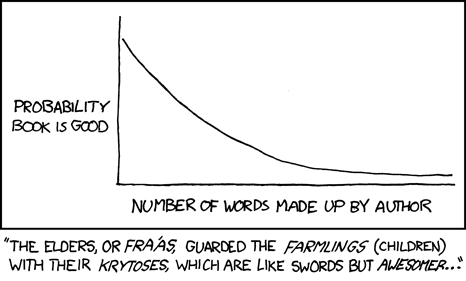
Kemmer is well explained. I could only figure out the meaning of shifgrethor through the internet, and even then it's unclear. There's also the Gethenian calendar, which is constantly being referred to, and which has no similarity to our calendar (of course). And the Gethenians have numerous words for snow, which are also often used. This seems unnecessary because Genly is translating to us from their language. Instead of using this particular word for snow, he could just say "sleet" or "slushy snow" or whatever. As if that isn't enough, Gethenians often have lengthy and complicated names which are not so different from the names of their months or their many words for snow. Often I got so bogged down in alien language that I got lost.

Of course, China Mieville also used his own made up calendar in The Scar, and it didn't cause any problems for me at all. The language isn't the only obstacle here. The pacing was very slow, and the story had no clear direction for a long time.

This is not the fault of the author at all, but while I've been finishing up the book, the weather here has been of the winter season so far. As I'm struggling to get my apartment warm, I've also been reading about Genly Ai and Estraven crossing over frozen lands that are barely hospitable to life. It's been a bit too easy to imagine their conditions. That last section of the book, when Genly and Estraven rely on each other closely for survival, is when Genly finally understands Estraven and shifgrethor. The book doesn't make it any clearer to the reader, though.

I think Le Guin was reaching for some very big concepts when she wrote this book, and she just didn't fully realize them all. I recognize that this book symbolizes a change in sci fi from stories about technology to stories about people, and that's certainly a contribution that changed the genre. But like so many influential works, it's rough and messy. The stories it inspired were more well crafted than this. It's value is obvious, but it's a dense read and doesn't really pay off at the end.

-------------------------------------------

I've decided to take the Christmas holidays off and read some comics, which is my favorite way to spend a hiatus. This hiatus was inspired by Neil Gaiman's recent spot on Talk of the Nation. Neil was discussing The Best American Comics 2010, which he edited. I'd never stopped to consider that there are comic book anthologies, and hearing about this really thrilled me.

The Best American Comics 2009See, some time ago my comic book guy was fired. I don't really care the reason why he was fired (and in case you were wondering the owner did not say it was theft when he gave me a lengthy and extremely unprofessional lecture on why he did fire him). My comic book guy read everything, and every time I came in to the store he had recommendations for me. He was also a good, non-judgmental comic book guy. The store owner is more like the comic book guy on the Simpsons, and regularly let me know that he hated everything I was buying (let me translate that for you - I don't read superhero comics, and so he hates everything I read because that is all that he reads). Basically, no matter what may have been wrong with my comic book guy as a worker, he caused me to buy comics through his excellent recommendations. The owner, on the other hand, drove me off because I really have no desire to patronize a store where the owner openly despises my patronage.

So I stopped buying comics from Jerky McNerdy-Snob's Comic Shop, which works just fine as a statement of my displeasure, but left me in the lurch by way of new comic book recommendations. I tried getting comic book recommendations from the internet, but it wasn't all that helpful. I don't get that personalized touch I got with my comic book guy, who knew my tastes.

The Best American Comics 2006 (Best American)So this anthology comes as a real delight to me, because it provides a survey of stuff that I can browse through and pick what I like, and pursue it further. I immediately went to the library catalog and found the volumes for 2006 through 2009. They have them at the library! Actually they don't because I reserved them all and checked them out tonight. So wait your turn.

Now, I'm looking forward to a merry Christmas made all the merrier through new comic book discovery.

On that note, this is most likely my last post of the season, and also the year. Merry Christmas and Happy New Year!

Monday, November 15, 2010

Sourcery finished; The Left Hand of Darkness started

The Left Hand of Darkness
Wow, that was just a week. I think that's record timing for me.

Sourcery was everything I expected - funny, enjoyable, well written. If you've never read anything by Terry Pratchett, you really should. The Discworld series (which Sourcery is from) is a fantasy series that spoofs fantasy novels. If you don't feel like committing to a series, no problem - you can really start with any book in the series. Some of the characters are recurring, but the books don't need to be read in any particular order.

Even though I've really loved this series so far, I find it really hard to review comedy. So I decided that a section of the novel would represent the story the best:

"What on earth are you doing?" said Conina, not taking her eyes off the ghastly figure.
"I'm looking up the Index of Wandering Monsters," said Nigel. "Do you think it's an Undead? They're awfully difficult to kill, you need garlic and-"...
(a short while later)
"Of course, it could be a Zombie," said Nijel, running his finger down a page. "It says here you need black pepper and salt, but-"
"You're supposed to fight the bloody things, not eat them," said Conina.
The Discworld series seems to be getting better as it goes along. Sourcery had me laughing more than any of the others so far, but so did Mort (the last one I read), but so did Equal Rites (the one before that). Good books, highly recommended.

-------------------------------------
Next up is The Left Hand of Darkness, by Ursula K. LeGuin. I haven't read any of her novels before, although I feel like I've always been aware of her as an author. I'm afraid to give an opinion of her in advance or even to feel excited about this, because every time I do that with a writer that's new to me, I end up hating the book.

Sunday, November 7, 2010

Lost Souls finished; Sourcery started

I've finished Lost Souls, this year's Halloween vampire selection.

I did not like this book.

As always with books that I dislike, the main thing that nags at me is the writing. All along I've been thinking of situations in the story that were offensive to me (more on that later) but in the end, the very thing that made them offensive is not that they are in the story, but how they are used in the story. It's all in the style, not in the subject.

My main critique is that this feels like a teen novel. To clarify what I mean, there are very good quality novels that are about issues that concern teenagers primarily, but that can be enjoyed by adults as well because of the quality of the writing. Then there are teen novels, which are dummied-down to a low reading level and deal with subjects within a very narrow world view. In other words, they are novels that insult the reader's intelligence and don't ask the reader to think very much. Lost Souls falls more into the latter category.

Lost Souls also leans very heavily on shock value. Adults having sex with teenagers is a common scenario, but not a theme - the situations are merely lewd and gratuitous. There are also two incestuous relationships in the novel. One involves the non-vampires, a man and his teenage daughter. The scene is detailed graphically, which is absolutely cringe-inducing to read. Nothing screams exploitation like an incest scene written as if it's supposed to be hot. There's no real purpose behind it, other than his daughter has boobies now, and has messed up values because she takes Dracula a bit too seriously.

And yes, really, there's a girl in the book who has messed up values because she reads. There are numerous references to Dracula in this book, and plenty of gothic kids who want to be vampires. Apparently they want it so much, they are willing to prove themselves through acts of depravity. It reads like a true crime novel from the Satan-scare 80s, that strives to convince you that all goths are so obsessed with vampires that they set bizarre and depraved goals of initiation upon themselves. I heard that they have to break every one of the 10 commandments! I heard that they have to commit each of the seven deadly sins! I heard that if you see someone driving at night with their lights off, you shouldn't flash your lights to warn them, because it's really a car full of goths who are going to follow you and kill you and drink your blood!

Alas, these gothic kids cannot become vampires, because in this book vampires are born, not made. You know how with every vampire novel, the author feels the need to rewrite the vampire myth? This one is no different: a vampire is created when a vampire has sex and becomes pregnant or impregnates someone. This can include procreation with a human - humans can impregnate a female vampire, or carry a vampire child. The child kills the human at birth - so female vampires make a great effort to not get pregnant. As a safety against abortion, vampire spawn effect the mother's brain so that she puts the survival of the child first. These children - even though they are part human - are not dhampirs, but vampires. Older vampires have fangs, can walk in the sun but are less tolerant of it, and are unable to consume anything but blood. Meanwhile younger vampires can frolic in the sun all day and eat whatever they like, although blood is what truly nourishes them. But they don't have fangs so they have to file their teeth. This is not, again, because they are all half-human, but because of evolution. Vampire evolution. Fairly rapid evolution, thank you very much Mr. Darwin.

I can see where writers find it interesting to make their vampires their own, but the changes in this novel come rather close to the baseball playing, sparkly in the sunlight variety. Furthermore, the vampire's chief role is to symbolize taboo subjects that humans have trouble facing. It seems like a waste of time to put all this effort into defining what a vampire is if there is a story to tell - we know what vampires are, ya'll. They drink blood, they like the night, they have sex with absolutely everybody. Yes, get on with it - what's this story about?

And what this story is really about is how we are just as bad as the vampires. Every disgusting thing a vampire does is mirrored in a human's actions. The writing goes to great lengths to show that just living is a disgusting act. Even moments that seem meant to show some kind of tenderness between characters attempting to make a connection with one another are spoiled by the incessant use of the word "spit" every time two people kiss. Bodily fluids abound. Gluttonous young vampires eat junk food non-stop, spewing cake when they talk and smiling through chocolate-smeered teeth. For what reason?

Because we are all disgusting. We are all bags of spit and snot and blood, doing gross things like kissing and eating, like, all the time. The monsters and us, we are exactly alike.

I can just hear some ridiculous nihilistic teenager saying "whoa. We are all monsters." Maybe that teenager was me, once. I want to go back in time and smack her upside the head. Snap out of it, kid! Life ain't so awful!

-----------------------------------------------

SourceryNow that that's over with, I've decided to start a new trend. Every time I read a novel that I dislike, that offends the intellect and the senses, that makes me feel like my brain needs to be cleansed, I'm going to follow it with a book from the Discworld series. There are quite a lot of them, and they are witty and charming, so it's the perfect change of pace. So now I've started reading Sourcery by Terry Pratchett. So far it's funny and doesn't make me feel like I can't read it while eating. I feel quite confident that it will remain that way throughout.

Tuesday, October 19, 2010

The Scar finished; Lost Souls begun because Halloween means vampires!

The Scar took quite a while to finish, but it's been a really enjoyable read. This book definitely puts Miéville on the list of authors that I want to revisit.

The title of the book is also the main theme of the story - scars, and what they represent. The title is a bit heavy-handed, because scars are mentioned throughout the entire story with very little subtlety, always pointing back towards the title, always reminding you that today, class, we will be discussing scars. However, the story and the characters - all damaged, scarred, if you will - are written so well that this is completely forgiveable. I'm not really sure how the author carries this off, but it's a good trick (well, he carries it off with good writing, I suppose, but beyond that I've got nothing).

Miéville refers to his style as "weird fiction" after the style of Lovecraft, which would suggest that we are in for some strange and nightmarish creatures, and he does not disappoint. Sea monsters! Human prisoners punished by being remade into half-creature, or half-machine! A lot of different words that mean "vampire" (oupyr, loango, katalkana, haemophage, and ab-dead - I'll bet Buffy never knew all that)! As scary as these creatures are, however, none of them are two dimensional, merely evil and murderous without motivation (this same respect extends to the protagonists as well - he relies very little on cliches and archetypes). Also, like his fellow creator of "weird fiction" Guillermo del Toro in Pan's Labyrinth, Miéville explores the notion that storytelling helps us to persevere.

Above all, Miéville creates a world that is fully engrossing. The story takes place in a city that is constructed of a massive number of ships, and governed by pirates. The moving city travels slowly around the ocean, occasionally sending out invaders to claim other ships. The ships become part of the landscape, their crew becomes prisoner citizens - unable to leave the city, but now free and equal regardless of race or class, whether human, un-human, or remade. While reading, I found it very easy to imagine this world and immerse myself into it. The feeling of living in the story is possibly the part that I liked best.

-----------------------------------------------

Lost SoulsNext up is Lost Souls by Poppy Z. Brite. In celebration of Halloween, I'm reading a vampire story. Last year I read Dracula to celebrate the holiday, and this year's selection is far more modern. Brite's novel is about vampires who gather in a club in North Carolina, and then go on a road trip to New Orleans, because that's where any American vampire really ought to be (for some unfathomable reason I started to write their road trip destination as South Carolina - which would make these vamps really lame). The comparisons to Anne Rice seem so obvious that I've decided to ignore them. I've heard good things about Brite, so I'm giving her the benefit of the doubt.

Friday, October 1, 2010

From Hobbiton to Rivendell.

A friend of mine mentioned the Eowyn Challenge on Facebook, and now after talking about it with her for a while I've decided to take the challege. Amanda and I are starting walk #1: Hobbiton to Rivendell! This all starts officially with our Step Out Against Diabetes walk tomorrow morning. If you want to support me, you can do so anytime within a month of the walk. Just click here.

Monday, September 13, 2010

The Scar started

The ScarI've begun reading The Scar by China Miéville. Since I've begun working on this reading list, I've been checking out online reading clubs and sites that cover science fiction more often (especially Sword and Laser and io9), and China Miéville's name keeps coming up. So coming off of my Dragon*Con related novel hiatus, it seemed appropriate that I check out this author and see what has generated all this attention.

The Scar is about sea monsters and pirates, two subjects where you have to be quite a screw-up to go wrong. So although I'm so early in the novel that even the back cover description contains spoilers, I am hopeful about the content.

What has me even more excited, however, is the bit of research I've done on Miéville. First of all, he's only 9 months older than me. The guy is closer to my age than any other novelist I've ever read, and I'm excited about reading some sci fi from my own generation.

I want those earrings.
Secondly, he looks really cool.

That's not something that normally interests me in an author. But then, how often do authors look cool? OK, yes, I do understand that Neil Gaiman possesses a cool factor of his own, but in an elder, writer as rockstar way. But please, name some other author that looks cool (seriously, do it. I will post pictures, and we'll talk it over). Even the coolest ones won't pull off the look that Miéville has, a little punk, a little like a tough guy. But you know, a cool tough guy. The older guy at every punk show, who tells you to stick by him because there won't be any moshing where he is. And you do, because you're quite certain that he's right.

So, all of that is a whole bunch of cult of personality, which doesn't normally influence the way I read a novel. Time will tell how I feel about the story. I'll let you know all about it when I'm done.