Showing posts with label Neil Gaiman. Show all posts

Thursday, December 16, 2010

Finished Left Hand of Darkness; started a hiatus

I finally finished The Left Hand of Darkness by Ursula K. Le Guin. I'm just going to dive right into a brief description of the book, and then I'll talk about my impressions.

The story is about an envoy - Genly Ai -who is originally from earth, and who is sent to a planet to represent a galactic alliance of planets, which would like for this new planet to join up. The planet - which is called Gethen - is unaware of life on other planets. Right away, imagine the difficulty involved. Imagine if an alien came to earth and wanted to address us all us "earthlings" and ask us to join his planetary union. All the nations, agreeing on one thing. I'll note that while Le Guin kind of simplifies the nations of the planet in this story, she also makes it clear that an entire planet of nations agreeing on one thing is a bit difficult to accomplish.

Genly Ai has several troubles to overcome. The nation he lands in, Karhide, has bizarre politics that he doesn't understand. They have a system of honor and respect called "shifgrethor" in which they seldom speak plainly, which allows them to save face. They very seldom speak straightforwardly. The other Gethenian nation he deals with is Orgoreyn, where people act very straightforwardly but there are often hidden purposes behind it.

Additionally, almost all people of Gethen are androgynous. They have no gender except for when they go into "kemmer" once a month, which is basically like an animal going into heat. At that time their bodies choose a gender, and not necessarily the same one every time - one person may be a father to some children and a mother to others. There are occasional anomalies on Gethen in which a person is born with a gender and stays in that gender all the time. These people are considered perverts, as is Genly Ai. Meanwhile, Genly has trouble relating to these androgyns. He tends to characterize them all as men when they are not in kemmer, but is often put off by any feminine traits he sees in them.

Finally, Gethen is in an ice age. The conditions there are much colder than he is accustomed to, which leads to numerous hardships.

So clearly, Le Guin bit off a lot with this story. The book was published in 1969 when women writers were not very common in sci fi. While the feminist aspect of the story is not nearly the most significant issue, it's difficult for me to read this without concluding that Le Guin was overly eager to prove herself. There are just so many things - politics, gender, man vs. nature, war - the Gethenians have no word for war. They do not have wars, and it is suggested that this is because they have no gender, but this is not defended. I believe that she intentionally left it uncertain, but it's just one of many unresolved issues that left me feeling like the story was incomplete. My best sense of what the story is about is an outsider learning to understand a different race of people, and the story gets there eventually through the relationship between Genly Ai and Estraven, a Prime Minister of Karhide who assists Genly throughout the story. But it's a very slow story of understanding, partly thanks to the many sidetracks into other themes.
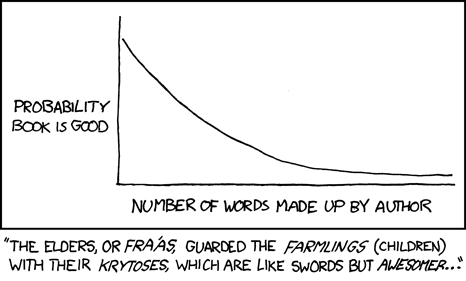
And then there is the language.

Kemmer is well explained. I could only figure out the meaning of shifgrethor through the internet, and even then it's unclear. There's also the Gethenian calendar, which is constantly being referred to, and which has no similarity to our calendar (of course). And the Gethenians have numerous words for snow, which are also often used. This seems unnecessary because Genly is translating to us from their language. Instead of using this particular word for snow, he could just say "sleet" or "slushy snow" or whatever. As if that isn't enough, Gethenians often have lengthy and complicated names which are not so different from the names of their months or their many words for snow. Often I got so bogged down in alien language that I got lost.

Of course, China Mieville also used his own made up calendar in The Scar, and it didn't cause any problems for me at all. The language isn't the only obstacle here. The pacing was very slow, and the story had no clear direction for a long time.

This is not the fault of the author at all, but while I've been finishing up the book, the weather here has been of the winter season so far. As I'm struggling to get my apartment warm, I've also been reading about Genly Ai and Estraven crossing over frozen lands that are barely hospitable to life. It's been a bit too easy to imagine their conditions. That last section of the book, when Genly and Estraven rely on each other closely for survival, is when Genly finally understands Estraven and shifgrethor. The book doesn't make it any clearer to the reader, though.

I think Le Guin was reaching for some very big concepts when she wrote this book, and she just didn't fully realize them all. I recognize that this book symbolizes a change in sci fi from stories about technology to stories about people, and that's certainly a contribution that changed the genre. But like so many influential works, it's rough and messy. The stories it inspired were more well crafted than this. It's value is obvious, but it's a dense read and doesn't really pay off at the end.

-------------------------------------------

I've decided to take the Christmas holidays off and read some comics, which is my favorite way to spend a hiatus. This hiatus was inspired by Neil Gaiman's recent spot on Talk of the Nation. Neil was discussing The Best American Comics 2010, which he edited. I'd never stopped to consider that there are comic book anthologies, and hearing about this really thrilled me.

The Best American Comics 2009See, some time ago my comic book guy was fired. I don't really care the reason why he was fired (and in case you were wondering the owner did not say it was theft when he gave me a lengthy and extremely unprofessional lecture on why he did fire him). My comic book guy read everything, and every time I came in to the store he had recommendations for me. He was also a good, non-judgmental comic book guy. The store owner is more like the comic book guy on the Simpsons, and regularly let me know that he hated everything I was buying (let me translate that for you - I don't read superhero comics, and so he hates everything I read because that is all that he reads). Basically, no matter what may have been wrong with my comic book guy as a worker, he caused me to buy comics through his excellent recommendations. The owner, on the other hand, drove me off because I really have no desire to patronize a store where the owner openly despises my patronage.

So I stopped buying comics from Jerky McNerdy-Snob's Comic Shop, which works just fine as a statement of my displeasure, but left me in the lurch by way of new comic book recommendations. I tried getting comic book recommendations from the internet, but it wasn't all that helpful. I don't get that personalized touch I got with my comic book guy, who knew my tastes.

The Best American Comics 2006 (Best American)So this anthology comes as a real delight to me, because it provides a survey of stuff that I can browse through and pick what I like, and pursue it further. I immediately went to the library catalog and found the volumes for 2006 through 2009. They have them at the library! Actually they don't because I reserved them all and checked them out tonight. So wait your turn.

Now, I'm looking forward to a merry Christmas made all the merrier through new comic book discovery.

On that note, this is most likely my last post of the season, and also the year. Merry Christmas and Happy New Year!

Monday, September 13, 2010

The Scar started

The ScarI've begun reading The Scar by China Miéville. Since I've begun working on this reading list, I've been checking out online reading clubs and sites that cover science fiction more often (especially Sword and Laser and io9), and China Miéville's name keeps coming up. So coming off of my Dragon*Con related novel hiatus, it seemed appropriate that I check out this author and see what has generated all this attention.

The Scar is about sea monsters and pirates, two subjects where you have to be quite a screw-up to go wrong. So although I'm so early in the novel that even the back cover description contains spoilers, I am hopeful about the content.

What has me even more excited, however, is the bit of research I've done on Miéville. First of all, he's only 9 months older than me. The guy is closer to my age than any other novelist I've ever read, and I'm excited about reading some sci fi from my own generation.

I want those earrings.
Secondly, he looks really cool.

That's not something that normally interests me in an author. But then, how often do authors look cool? OK, yes, I do understand that Neil Gaiman possesses a cool factor of his own, but in an elder, writer as rockstar way. But please, name some other author that looks cool (seriously, do it. I will post pictures, and we'll talk it over). Even the coolest ones won't pull off the look that Miéville has, a little punk, a little like a tough guy. But you know, a cool tough guy. The older guy at every punk show, who tells you to stick by him because there won't be any moshing where he is. And you do, because you're quite certain that he's right.

So, all of that is a whole bunch of cult of personality, which doesn't normally influence the way I read a novel. Time will tell how I feel about the story. I'll let you know all about it when I'm done.

Tuesday, June 29, 2010

His Dark Materials trilogy started

The Golden Compass: His Dark Materials
I've started The Golden Compass, first in the His Dark Materials series by Philip Pullman.

I've never seen the movie version of this book, and I don't know much about it. When the movie came out there was a minor media fury over whether the story contains "hidden" messages against the Catholic church. I've never really believed in hidden messages corrupting people - if you have a message to get across, you'll most likely just say it, not hide it. Also, Pullman's feelings about organized religion aren't exactly a secret.

At any rate, I'm not the kind of person who thinks that criticizing religion is a bad thing, nor do I think it's inappropriate for kids. I'm a little interested to see if these religious themes stand out to me.

I'm also seeing some reflections of Narnia in the story so far. Not just the talking animals - that sort of thing shows up in a lot of stories, and is certainly not particular to C.S. Lewis. I was just discussing The Chronicles of Narnia with a friend of mine, and how Susan was not allowed to go back to Narnia because she discovered makeup and boys. Basically, puberty, womanhood, and an interest in sex exclude her from the kingdom of heaven. This has been criticized quite a lot, by such notables as J.K. Rowling and Neil Gaiman (no link for Neil because I couldn't find this online: if you want to know more just read his story The Problem of Susan, which you can find in Fragile Things).

The hero Lyra in The Golden Compass is a tough, somewhat tomboyish girl, but is beginning to show an interest in makeup and clothes at the part that I'm reading right now. It kind of reminds me of Narnia by contrast - in the book that happens last chronologically, Susan has basically become too interested in womanly things - this is presented as something that happened because she's no longer a child. Lyra is still very young and it's very early in the story, but she's showing an interest in womanly things. This is certainly the way I remember things happening when I was young. Girls like to look womanly. It's pretty normal for girls to want to wear makeup and have nice clothes, even at an early age.

I'm not sure I want to make an anti-Narnia argument for The Golden Compass just yet. Instead, I'll just say it's been pretty good so far, and I think that in this children's story it might actually be ok for a girl to wear makeup. The storytelling is engaging and I've been reading through pretty fast. More news when I'm done!

Sunday, June 27, 2010

Fight Club finished: spoilers in abundance

Spoiler alert! If you have never seen the film Fight Club, this review will completely ruin it for you. This review is for the book, not the movie, and is operating under the assumption that you have probably seen the movie. It gives away - very early on - information that would spoil either the movie or book for you, assuming you've experienced neither, which must mean that you were born yesterday. You've been warned; proceed with caution.

Additionally, extensive credit must be given to Neil Gaiman. I wouldn't know about all these gods if it weren't for his very engaging use of them. Thank you also, people of the Internet, for researching the gods that Mr. Gaiman writes about and compiling it all onto one web page. I have to do almost no research, thanks to all of you.

I have read Fight Club faster than any book in this list. For one thing, it is among the shortest and quickest reads in the list so far - if not the shortest. I think it gives the individual Narnia books a run for their money in brevity.

Also, I couldn't put it down.

For the purposes of this review, I'll be calling the main character of the book the Narrator - coincidentally, this is also how he is credited in the film. Some people like to call him Jack. In the book, it's Joe. Joe's raging bile duct. Joe's complete lack of surprise.

It doesn't make a difference to me whether it's Joe or Jack - neither of these are his name, which is made quite clear in both the book and movie. But still, you just know that some movie executives sat around in a room and decided that Jack was a better name than Joe. Jack would market better.

Reading Fight Club the novel brings my already developed interpretation of Fight Club the film into a much sharper focus. My interpretation is that Tyler Durden is a trickster god, and as tricksters love to do, he seduces the Narrator. It's not hard to do; just show a person a way of living he's never thought of before. Here's a bit of information that I picked up from somewhere that I can no longer remember, delivered in a style so reminiscent of a Tyler Durden philosophy that it's actually pretty cheesy: one of the dangers of being an American who is taken hostage is that we never expose ourselves to the other side's point of view. Why is our side right and the other side wrong? We don't know. We're just utterly convinced that our democracy is the best way that things can be. The other side is so wrong - whatever that other side is at any given moment - that we never expose ourselves to their ideas. They are wrong. Why waste time figuring out what they think when it's so wrong? So Americans who are taken hostage are subjected to lengthy challenges to their system of government. They are told it is wrong, and why. They are told the other side is right, and why. They have never been subjected to these types of arguments before.

And sometimes they become convinced, just because they can't argue back.

This happens to the Narrator. Does he have a reason for not getting into a fight? For not giving up everything he owns? For not living in filth? No, and so this means it's a good idea. If you can't disprove it, it must be right.

As a trickster god, Tyler Durden is especially good at convincing the Narrator. Tyler is never openly acknowledged as a god, but look at the man. He's the most fascinating thing in any room he occupies. And he creates chaos. Not because it's good for society, not because it breaks people free from their possessions (in the book, possessions are not made into a villain of society nearly as much as in the film). These are excuses he makes up as part of the seduction. He creates chaos for the sheer enjoyment of creating chaos, because it is food and drink to him. In the book, Tyler tells the Narrator about the brown recluse spider, and how its poison dissolves human skin. I'm reminded of Anansi Boys, a book by Neil Gaiman about the West African/Caribbean trickster god Anansi the Spider. That book makes notes of the many bizarre and torturous things that spider venom can do. It says that spider venom does this because spiders think it is funny.

Tyler thinks destruction is hilarious.

Tyler wants to destroy everything. Soon, so does the Narrator. Tyler wins him over with class struggle anger, and so the Narrator wants to destroy art museums. He wants to destroy fancy things that he will never be able to afford to enjoy. He wants to destroy every resource that isn't necessary for his personal survival. The Narrator is not anti-consumerist - he's anti-human.

It would be nice if noticing his selfishness made the Narrator realize something was wrong. It would be nice if Project Mayhem - which strips its members of their individuality, made him realize that things had gone too far. What really catches his attention is when Tyler leaves him, and breaks his heart - leading to the big reveal that Tyler is in the Narrator's body, and that to everyone else in the story, the Narrator is Tyler Durden. Only when he knows that Tyler is riding his back like the voodoo god Elegba, possessing his body for longer and longer amounts of time - only when he realizes that he may disappear and become Tyler - does the Narrator see the other side of the argument. Only when he realizes that he is losing his own body does he want his personality and his individuality back.

The book doesn't end like the movie. I won't fully give this part away, but it's not as dramatic and beautiful - no buildings falling, no fairy tale kiss. The ending in the novel also makes more sense. I always felt like the movie abandoned the plot in exchange for a dramatic ending - how are the Narrator and Marla going to survive past the ending in the film? The book ending isn't fully believable, nor is it as fun, but it does provide more closure.

Overall, the story is an epic myth condensed for the modern attention span. Gods do what they always do, because our mortality makes us curious and vaguely interesting to them. Once in a while they mess with us out of boredom. They abandon us when they become bored with that. Occasionally, if we are lucky or clever, one of us can defeat them.

Saturday, February 13, 2010

Equal Rites finished; Neuromancer started; Neil Gaiman in Tuscaloosa

Equal Rites was my favorite in the Discworld series so far. It's the story of a girl who is a wizard. In the Discworld women become witches and men become wizards for no reason other than that's the way things have always been. Which means, of course, that a change will require nothing less than a paradigm shift.

Feminism is definitely a major theme. One of my favorite moments in the book is when Esk's Granny Weatherwax faces off against a wizard, and they have a confrontational discussion about wizard magic (which is showy and powerful) versus witch magic (which is practical and useful - and also seldom used because psychology often works better). The conversation reminded me of nothing so much as what an argument between a doctor and a nurse might be like in an age when female doctors and male nurses were less common, with the nurse pointing out that while the doctor has his big important degrees and surgeries and diagnoses, the nurses are the ones who do all the work of actually helping people (which is true today as well, even though the fields are more gender-balanced).

It's very funny, and I think Pratchett was getting really comfortable with the Discworld and its possibilities at this point. Unlike the previous two novels, Equal Rites had a specific plot direction; the girl wizard Esk needs to get into the Unseen University, the school for wizards. I think when I originally began reading the first Discworld novel, The Color of Magic, I gave it up because the story was sort of a sprawled out thing (that, and because I was reading numerous things at once). I had a hard time focusing on the story. My second reading of The Color of Magic was far more rewarding, but it is nice to read a Discworld story that takes a more direct approach from beginning to end.

-----------------------------

I've decided to break from the Discworld series for now, and I've started Neuromancer by William Gibson. This is yet another one of the books that I'd tried to start reading at some point prior to taking on this project, and stopped reading because I didn't get into it. Upon taking it up again, I read the first 60 pages of it in one sitting. This is a very good start considering the speed with which I normally read. It is also the result of trying to burn an audiobook to iTunes while in a library, and learning that the laptop needed me to load some critical updates or else it would insist on crashing repeatedly all day long. It just goes to show that if you want to get a lot of reading done, all you really need is 3 hours in a library and a computer that requires 4 restarts and a number of downloads before it decides to cooperate with you.

Also, I think there is a lesson to learn from all the books I half-read before and have now started again to find that they are actually interesting. The lesson is that I don't multitask as well as I think I do.
----------------------------

I got to see Neil Gaiman on his recent visit to Tuscaloosa, where he read several short stories and did a Q&A. He even read one story that I am not familiar with, which is impressive because I tend to be on top of these things. I don't think I could sum up the evening as well as he did, so I'll just provide this link to his blog, and note that he's right, we do read and we do need more authors to visit. We especially need him to visit again, preferably with a signing next time.

Saturday, January 30, 2010

Faster than a Speeding Blog

I finished The Light Fantastic, and I'm now half-way into Equal Rites. I am reading faster than the speed of blog.

I don't have much to say about The Light Fantastic. It was good, it was funny, it made me want to start the next book in the Discworld series, and so I did.

I think I will have a bit to say about Equal Rites, especially regarding how it reminds me of Good Omens, the book that Terry Pratchett and Neil Gaiman co-wrote. Perhaps also regarding feminism, which has been on my mind a lot lately.

Specifically, Neil Gaiman was quoted, perhaps incorrectly, by the New Yorker as saying that he was "nobody's bitch". This resulted in him being accused of using a misogynist slur and of being a part of the "rape culture", which led to lots of emails sent to Gaiman explaining that "having used that phrase undid all the good I'd ever done by writing positive women, supporting RAINN etc, because it showed that I was minimising the horror of rape and revealing my underlying misogyny."

In the world of the Internet, it's a dead issue. It was talked about over a week ago, and in Internet time that's about 6 months. I bring it up now not in the hopes of you all rushing over to the apparent source of this mess to add your own comments, but because it's an intro to my own essay, titled What the Hell has Happened to Feminism?

Actually, "what the hell has happened to feminism?" is the title, the introductory statement, the full argument, and the closing statement of my essay.

I've used the "not your bitch" phrase a few times in my life, and I've never been accused of perpetuating the misogynist culture. I'd be really offended if I was accused of that. I don't think you can rightly accuse one person's words of determining another person's actions.

Mostly, I keep wondering if we feminists don't have better things to do. This seems like a classic example of a group being so busy arguing amongst themselves that they never accomplish anything. Here in America, women still don't always get equal pay for equal work. Prison sentences for rape are still ridiculously short. I think the important issues are the ones where you can actually change the way things are. I am also not into the whole "changing the dialogue" method of feminism, because that's just a touchy-feely way of saying "changing the way people talk," which is just a friendly way of saying "speech and thought control." Change laws, and hopefully a few people will stop to ponder why it was important that they be changed. Tell people what to think and say, and they will only get pissed off at you.

Not to mention, if feminism wants me to choose between them and free speech, they are going to lose me.

Thursday, July 23, 2009

When is a feminist not a feminist?

A few more notes on Stranger in a Strange Land, so that I can purge this all and move on:

Said best in this article in The Stranger: "Are there people who call themselves feminists in this day and age who would actually call this book feminist?"

Okay, he was talking about a different book by Heinlein, but I think this applies to Stranger in a Strange Land as well. Stranger is supposed to deal in part with feminism. I know this is true because it said so on the back cover of the book. As I read the book, however, I kept wondering where the feminism came in to play. All those men who talk too much are often condescending to women while doing so. The women didn't seem to be full of liberation either; one of them says that rape is the woman's fault 9 times out of 10 (she did not explain why this is, by the way, and I wish she had).

My thoughts on the subject only stray from The Stranger insofar as I don't think feminists of any age would call Heinlein's writing feminist. This book was published in 1961, and I find Virginia Woolf's writing - in the 2os and 30s! - far more advanced in terms of feminism. I suppose he can be apologized for from a number of angles, such as being a mere sci fi writer compared with Virginia Woolf. But I reject the notion that higher thoughts and better writing are restricted to classic literature, which is part of the reason why I am reading this list of novels!

So I keep searching for evidence of feminism. The women had jobs, but they were nurses and secretaries. The women were fairly strong-willed, but they were also ordered around a lot, usually being told to go cook dinner. I just don't see it. Anyone who has a different point of view on this is welcome to share.

----------------------------------

Following my completion of this novel, I felt like my brain needed cleansing. At first I craved Sherlock Holmes very badly. I guess I wanted the order and logic of his world, but I also didn't want to get fully involved in something that isn't on the list, short though the Holmes novels are.

I decided instead to read A Study in Emerald by Neil Gaiman. I think it is one of the most perfect short stories that Neil Gaiman has ever written. I'm a big Gaiman fan, and preferring this over some of his other works is like preferring that your favorite musician play cover tunes. Still, I have some favorite musicians who play very excellent covers, and likewise Neil Gaiman "covers" Sir Arthur Conan Doyle excellently. Or I should say, Doyle and Lovecraft - he was asked to write this as a story that combines the worlds of Sherlock Holmes and H.P. Lovecraft.

You can read A Study in Emerald online for free. If you don't like reading stories on a computer screen you could print it - it's designed to be very attractive - or you could read it from the book Fragile Things by Neil Gaiman, which is a collection of short stories.

Next up, The Strange Case of Dr. Jekyll and Mr. Hyde by Robert Louis Stevenson, which I think A Study in Emerald provides a good transition into. It mentions Dr. Jekyll, and a few other monsters from literature as well. I spent a few minutes today identifying them all, and I'm pleased and amused at their cameo appearances.